A · Attention
Look
A visual joke or metaphor earns the first few seconds.
A month-sized tour of the ideas that make artificial intelligence work — drawn rather than lectured. One sketch gives you the picture; the explanation, quiz, mind map, limerick and links let you go as far as your curiosity takes you.

The cartoon earns attention. Real examples make the idea relevant. Plain-English explanations and quick checks build confidence. Humour makes the effort feel worthwhile. Bite-sized learning makes it easier to keep going — the full ARCS-V motivational sequence.
A visual joke or metaphor earns the first few seconds.
See where the idea appears in life and work.
Plain English and quick checks make progress visible.
The joke and recognition reward the effort.
Small steps and optional depth let you choose the route.
Follow the sequence or jump to the topic you need. Every numbered title opens the original AIU learning page and cartoon.
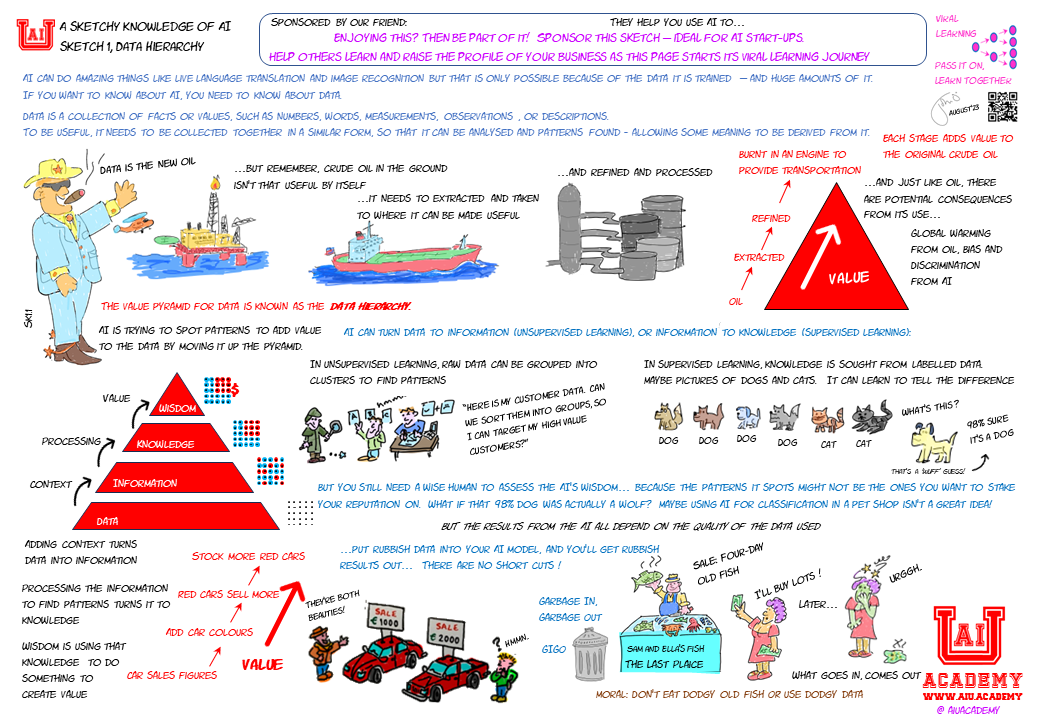
01 · Data hierarchy
02 · What is AI?
03 · AI use cases
04 · Why now?
05 · What is machine learning?
06 · Limitations of AI
07 · Machine learning tool box
08 · AI algorithms
09 · Neural networks
10 · Machine learning weights
11 · Activation functions
12 · The dangers of ML
13 · Accuracy, negatives & positives
14 · Understanding ML decisions
15 · Data wrangling
16 · Applying ML to your business
17 · Handwriting recognition
18 · Image recognition with CNNs
19 · Transfer learning
20 · Image segmentation
21 · Facial recognition
22 · GANs
23 · Speech recognition
24 · Natural language processing
25 · Text classifiers
26 · Chatbots & digital assistants
27 · Modelling text with RNNs
28 · Translation
29 · Text generation with ChatGPT
30 · The 4th Industrial Revolution
The field got its name at the Dartmouth Summer Research Project in 1956. Seeing where AI came from makes today's systems easier to place in context — and harder to confuse with magic.

Pick a sketch. Learn one thing. Tell someone else.