AI literacy without the lecture

30 sketches.
2 minutes a day.
AI that finally makes sense.

Learn the ideas and algorithms behind artificial intelligence through hand-drawn cartoons, plain English, quick quizzes, mind maps, limericks and links worth following.

Free for individuals and classroom teaching. Corporate and organisational use is licensed.
AIU Academy Data Hierarchy cartoonAIU hand-drawn learner at a desk
Look.
Laugh.
Learn.
30 visual AI sketchesQuick knowledge checksMind maps & limericksNo login needed
Use it your way

Made for curiosity.
Useful in the real world.

AIU is deliberately easy to enter and easy to share. Learn alone, use a sketch to explain an idea to a class, or bring the approach into a workplace where AI needs to make sense to everyone.

👀

Learn

One sketch at a time. Start with the picture, read as much as you need, test yourself, then move on.

Open the sketch index →
✏️

Teach

Use the cartoons to start informed conversations about AI without beginning with equations, hype or fear.

See the design approach →
🏢

Bring it to work

License the existing library or commission bespoke cartoons and learning around your own business, AI use cases and vision.

Explore corporate use →
Who is it for?

AI affects more people than
AI specialists.

AIU is designed for people who need enough understanding to participate confidently — whether they are learning for themselves, explaining AI to others, or helping an organisation decide what to do next.

🙂

New to AI

See the landscape quickly, without starting with mathematics or jargon.

🧑‍🏫

Explaining AI

Teachers, specialists and communicators can use visual metaphors to make difficult ideas discussable.

🏢

Making AI useful at work

Teams and L&D functions can connect AI concepts to real organisational use cases and decisions.

Motivational design

Not cartoons added to a course.
A course designed around motivation.

AIU is informed by John Keller’s ARCS-V model. Each layer of the experience has a job: earn attention, establish relevance, build confidence, reward the effort and help the learner keep going.

A · Attention

Make me look

Cartoons, visual metaphors and humour interrupt the usual wall of AI text.

R · Relevance

Make it mine

Everyday examples — and bespoke corporate use cases — connect ideas to the learner’s world.

C · Confidence

I can get this

Plain language, layered explanations, mind maps and quick checks make progress visible.

S · Satisfaction

Worth my time

The joke, the recognition and the quiz result reward the learner for staying with the idea.

V · Volition

Keep going

Bite-sized sketches and optional deeper links let learners choose their path and continue.

AIU cartoon learning sketch
“The cartoon gets you in. The relevance makes you care. Understanding gives you confidence. The joke rewards you for staying.”

That is the design logic behind AIU Academy.

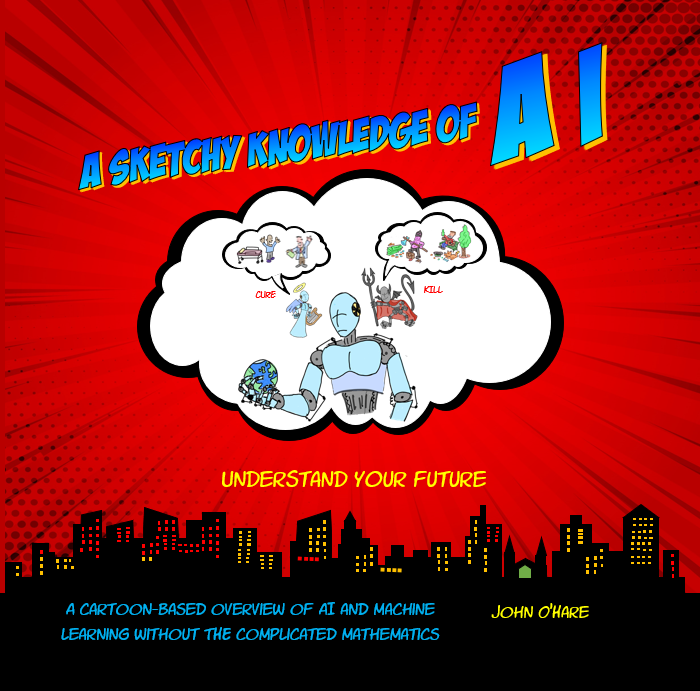
From A Sketchy Knowledge of AI

Take a look.
You’ll get the picture.

The academy opens out the cartoons from the book with extra routes into the idea: quizzes, limericks, mind maps, external links and prompts for discussion.

For everyone

Essential knowledge should be accessible.

AIU is free for individuals and classroom teaching. If it helps, the simplest way to support it is to buy the book.

For organisations

Make your AI story understandable.

Use the AIU library with teams, or commission cartoons and learning assets built around your own strategy, use cases and vision.

First draft of A Sketchy Knowledge of AI signed by Marcus Weldon, then President of Bell Labs
A sketch with a serious pedigree

Three degrees of separation from the birth of AI.

The first draft of A Sketchy Knowledge of AI was signed by Marcus Weldon, then President of Bell Labs.

Bell Labs was home to Claude Shannon, one of the participants in the 1956 Dartmouth workshop that gave artificial intelligence its name.

Marcus Weldon → Bell Labs → Claude Shannon → Dartmouth

Admittedly, the connection is a little sketchy. But then, so are the cartoons.

Two minutes is enough to start.

Pick a sketch. Learn one thing. Tell someone else.

Start with sketch 1 →